Title here
Summary here
In the current version of the Green Metrics Tool we changed our
measurement approach from just containing the data for the runtime of the software
to also look at other stages of the lifecycle of software.
Software has not only to be run, it also has to be
developed, tested, installed, booted and removed.
The Green Metrics Tool currently supports the following phases:
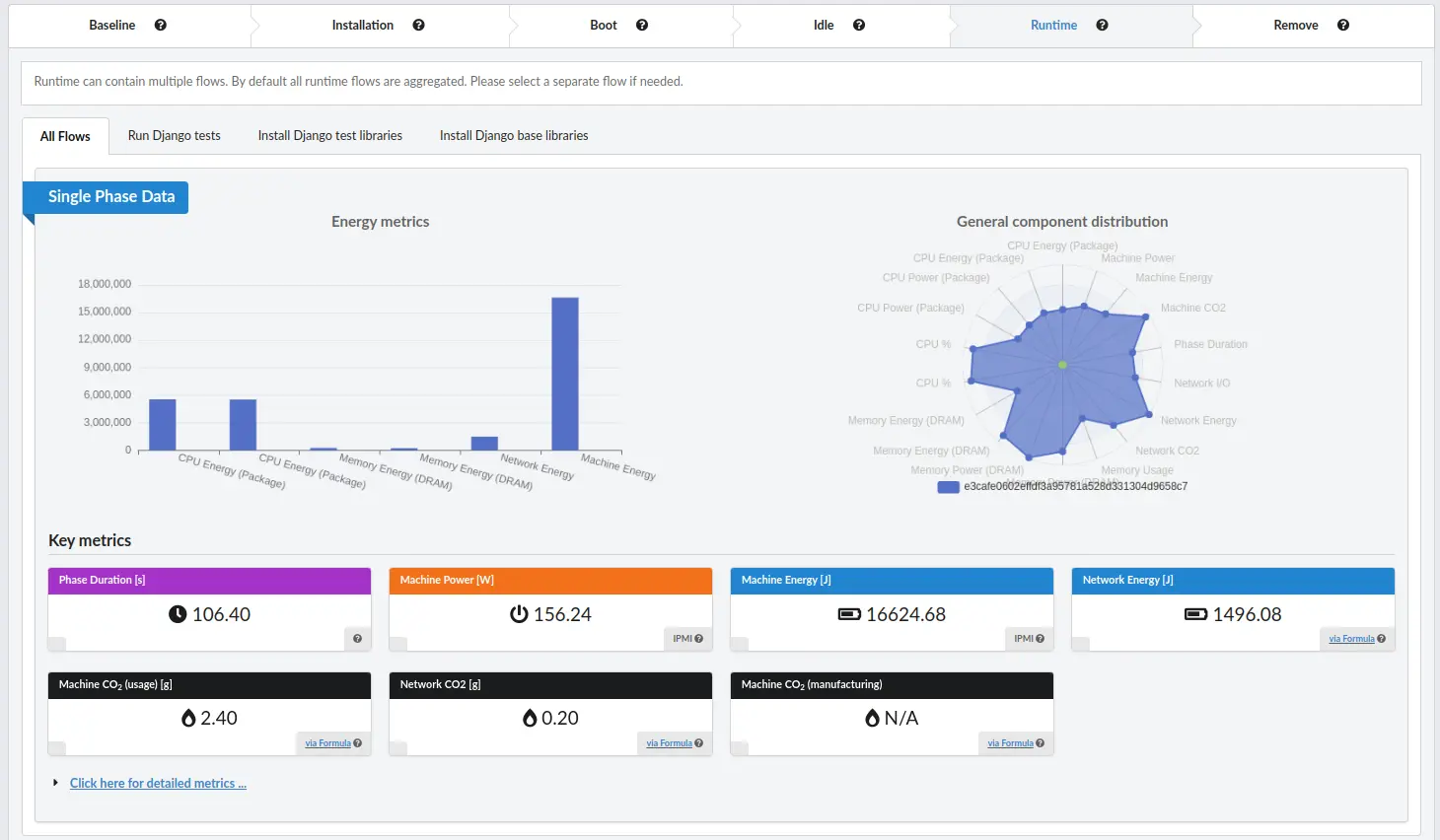
These phases originate from the idea to look at software from a lifecycle perspective,
similar to how ISO 14001 and also the Blue Angel for software does.
Measures the system with metric providers enabled, but without the application.
The purpose of this phase is to get a familiarity with the load on the system
when no application is running.
The images specified in the usage-scenario.yml file are pulled
or built from local Dockerfiles.
The building of Docker images happens within a container running Kaniko.
The images built in the previous phase are orchestrated and the application is started.
The application is now running and waiting to start running flows.
Complementary to the baseline phase, we measure the load
on the system when the application is running.
This is the phase where the flows that were specified as part of
the usage-scenario.yml are run within the orchestrated application.
In this phase the application architecture is being taken down
and metric providers are being stopped.
The system returns back to baseline and the measurement process is finished.
Metric providers sample continuously in the background at their own configured
interval, independent of when a phase starts or ends. Because a phase boundary
can fall anywhere between two sampling ticks, the very last reading before the
boundary could otherwise be cut off and lost from the phase it actually belongs to.
To avoid this, GMT automatically pads the end of every phase by one extra
sampling tick, so that a reading which happened just before the boundary is
still included. This is done transparently and needs no configuration.